MUD
Glossary terms related to Multi-User Dungeons (MUDs). MUDs come in a wide variety of forms. Traditionally, they are multiplayer games played via telnet.
Latest posts

Telnet
What is Telnet? Telnet is a basic way to connect to another computer over the internet using just text. In text-based roleplaying games like MUDs (multi-user dungeons), it’s often used to log into the game’s server and interact with the world by typing commands. Players use Telnet to explore, talk, fight, and roleplay – all

Parser
What is a parser in text games? A parser in interactive fiction (IF) is the system that reads and interprets player input, turning it into actions within the game. When you type commands like “open door” or “take lantern,” the parser figures out what you mean and responds accordingly. More advanced parsers can handle complex
Wholist
What is a wholist? A wholist is a list that displays the names of all players currently online in a text-based roleplaying game, such as a multi-user dungeon (MUD). This list allows players to see who else is active in the game at the same time. The wholist can often be accessed through a simple
Smallrooming
What is smallrooming? Smallrooming is a specific behavior observed in multiplayer text-based games, particularly in MU*s, where players fail to realistically incorporate the broader game environment into their roleplay. This can lead the game spaces, which may actually be expansive or crowded, to feel unrealistically small or intimate. For instance, players might interact as if
S&S
What is S&S? S&S is short for “sword and sorcery.” It’s a subgenre of fantasy literature and gaming that features sword-wielding heroes engaging in violent, often personal adventures. The narratives typically focus on action-packed encounters, magic, and personal quests rather than the grand epic battles or political intricacies found in other genres, such as L&L.

Sparring
What is sparring? Sparring is a form of combat in roleplaying games (RPGs) that simulates a fight or duel between characters primarily for training purposes or to settle disputes within the game. Unlike other forms of player vs player (PvP) combat, sparring does not result in permanent character death (permadeath), making it a safer and

Spawn point
What is a spawn point? In text-based roleplaying games (RPGs), a spawn point is a designated location where characters, creatures, or items appear. This could be where new characters start their journey or where they reappear after being defeated. Spawn points are often set by the game master or determined by the game’s rules. They
Socials
What is a social? A social is a type of default action or behavior that players can take in multi-user dungeons (MUDs) to express themselves. Common examples include actions like laughing, chuckling, crying, waving, hugging, or nodding. Socials are typically used for social interaction and roleplaying purposes rather than gaining any specific gameplay advantage. They
Scripting
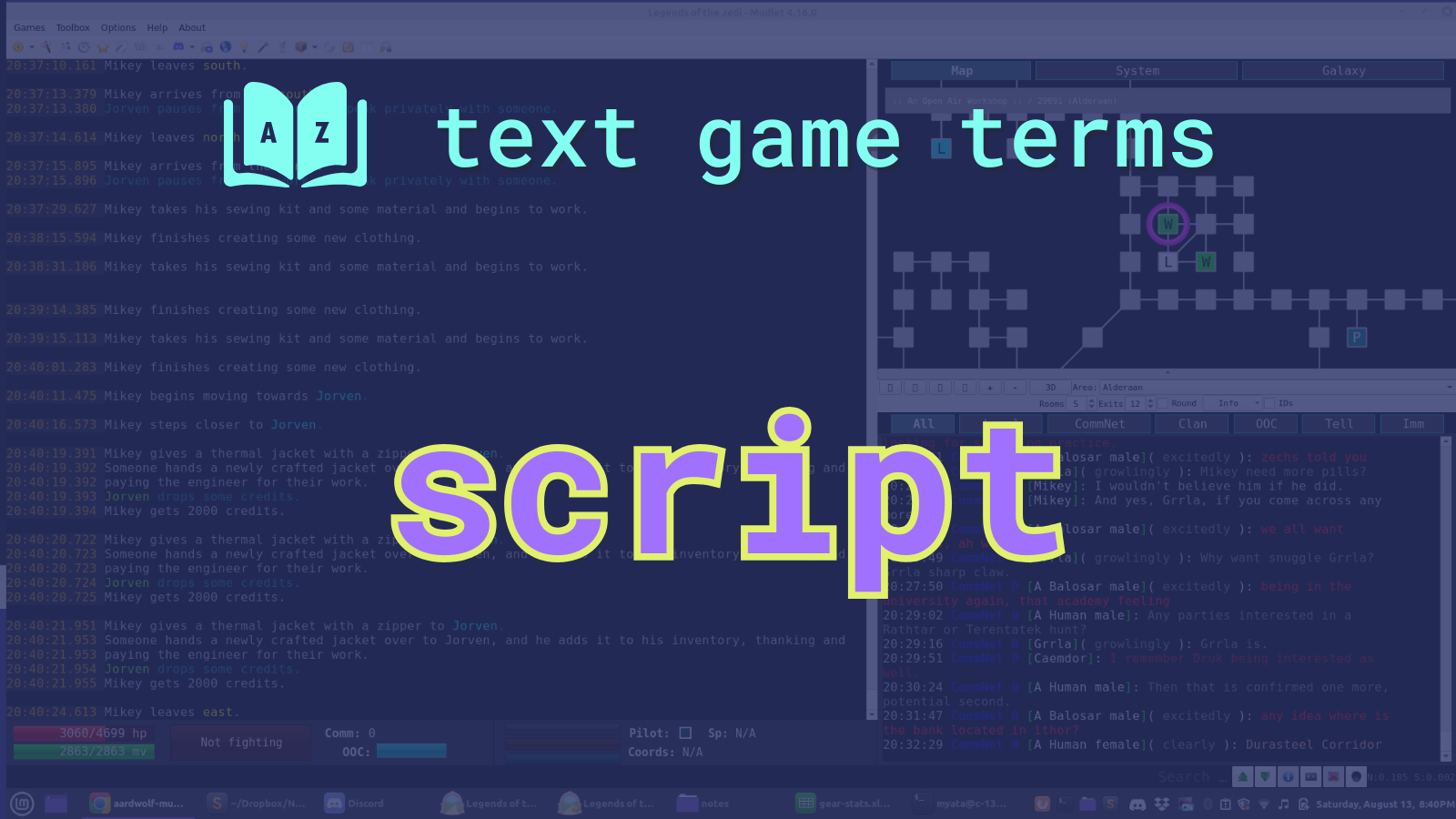
What is a script? In the context of MUDs and MUD clients, a script is a series of instructions written as lines of code that tells the client how to behave. Scripts automate repetitive or time-sensitive tasks like navigating specific paths, reacting to certain keywords, or casting spells. They allow players to optimize their gameplay

Screen reader
What is a screen reader? A screen reader is a software application that converts text displayed on a computer screen into speech. It’s an important tool for members of the VI community, allowing them to interact with various digital content including text-based games, websites, and software interfaces. Screen readers operate by reading the text aloud
Trolling
What is trolling? Trolling in a roleplaying context refers to behaviors intended to disrupt gameplay, provoke other players, or derail the narrative of the game. Trolls often engage in actions or dialogue that breaks game immersion, antagonizes players, or leads to non-constructive outcomes. Their tactics can vary from sarcastic remarks and annoying other characters to

Twinking
What is twinking? Twinking in the context of online games refers to various forms of cheating and undesirable behaviors where a player manipulates information or game mechanics to gain an unfair advantage. This can involve deceiving other players about their character’s abilities or exploiting game system loopholes. Twinking undermines fair play and is generally frowned

Room
What is a room? In the context of a multi-user dungeon (MUD), a room refers to any location that player characters (PCs) can occupy. While the term “room” might imply an enclosed space within a building, in MUDs, it extends to encompass a variety of environments. For example, a room could be a literal chamber,

Rollplaying
What is rollplaying? Rollplaying is a play style within roleplaying games (RPGs) where the focus is predominantly on the mechanics, such as dice rolls, character stats, and the strategic or tactical aspects of the game, rather than on narrative engagement or character development. This approach emphasizes the “game” aspect of RPGs, prioritizing success in combat

RL
What is RL? RL stands for “real life.” It’s a term used to differentiate the everyday, non-digital world from the virtual or game environments in which roleplaying, gaming, and other digital interactions occur. RL can be used as both a noun and an adjective. As a noun, RL refers to activities, responsibilities, and interactions that
Rent
What is rent? Rent in the context of multi-user dungeons (MUDs) refers to a game mechanic where players pay in-game currency to secure their inventory and equipment at an inn or similar safe location before logging out. By paying rent, players could ensure that their items persist in the game world between sessions. A brief
Remort
What is a remort? Remorting is a feature in some multi-user dungeons (MUDs) that allows players to restart their character after reaching the maximum available level or experience points, but with enhanced abilities or stats not available to first-time characters. This system is designed to extend gameplay and provide a sense of continued progression and

PvP
What is PvP? PvP stands for “player versus player,” a type of gameplay in roleplaying games (RPGs) where players directly engage in combat or conflict against each other rather than facing computer-controlled opponents. This interaction can occur in various forms such as duels, battles, or competitive matches, depending on the game’s structure and rules. PvP
PvE
What is PvE? PvE stands for Player versus Environment. In text-based roleplaying games, it refers to scenarios where players interact with the game’s world and its non-player characters (NPCs), rather than competing against other players. The focus is on overcoming challenges presented by the game itself, like solving puzzles, battling monsters, or completing quests. PvE
Pwipe
What is a pwipe? A pwipe, short for “player wipe,” involves the complete deletion of player data files from a game, effectively resetting the game environment. This allows for a fresh start for all players, often reinvigorating the game’s community and dynamics. Pwipes are particularly common in online text-based roleplaying games where player progression and

Puppeting
What is a puppet? A puppet in text-based roleplaying games (RPGs) refers to a non-player character (NPC) that is controlled by game administrators or storytellers to enhance narrative and interactive elements. Puppeting involves temporarily taking over an NPC to perform specific actions, deliver dialogue, or influence the game environment in a way that furthers the
Pseudolanguage
What is pseudolanguage? In multi-user dungeons (MUDs), pseudolanguage refers to strings of text that appear as unintelligible words and letters meant to represent a language unknown to the listener. When a character speaks in a language that another character does not understand, the text appears normal to the speaker but as garbled gibberish to the
Powergaming
What is powergaming? Powergaming (also spelled “power gaming” and “power-gaming”) refers to a style where a player prioritizes their character’s power and success over collaborative storytelling and character development. Typically, this involves creating and exploiting conditions in the game to maximize personal advantage without regard for narrative coherence or fairness to other players. In video
Pbase
What is a pbase? Short for “playerbase,” the term pbase refers to the collective group of players actively engaged with a particular game. This term is commonly used to describe the community aspect of games, particularly in online or multiplayer settings. A pbase can vary widely in size from just a few players to millions