It’s MU* history month!
Game admins and players are warmly invited share a bit of their game’s history. Learn more.
RSS

MUSH

Glossary terms related to MUSHes (Multi-User Shared Hallucinations). MUSHes are MU* games that generally focus on writing, roleplaying, and storytelling over coded systems and mechanics.
Latest posts

MUSH

MUSH

Aug 18, 2026

Aug 18, 2026

Maving

Maving

Aug 18, 2026

Aug 19, 2026

Grid

Grid

Aug 9, 2026

Aug 19, 2026

Pose Order

Pose Order

Aug 9, 2026

Aug 19, 2026

Fandom RP

Fandom RP

Aug 9, 2026

Aug 19, 2026

Obfuscation of Mechanics

Obfuscation of Mechanics

Aug 9, 2026

Aug 19, 2026

Command Prompt

Command Prompt

Jul 4, 2026

Aug 19, 2026

Keepalive

Keepalive

Jun 29, 2026

Aug 19, 2026

Telnet

Telnet

Jun 19, 2025

Aug 19, 2026

Wholist

Wholist

Sep 3, 2024

Aug 19, 2026

Screen reader

Screen reader

Apr 20, 2024

Aug 19, 2026

What is a screen reader? A screen reader is a software application that converts text displayed on a computer screen into speech. It’s an important tool for members of the VI community, allowing them to interact with various digital content including text-based games, websites, and software interfaces. Screen readers operate by reading the text aloud

Trigger (psychological)

Trigger (psychological)

Apr 15, 2024

Aug 19, 2026

What is a trigger? In the context of text-based roleplaying games (RPGs), trigger refers to any topic, action, or type of content that could negatively impact the well-being of a player, potentially causing emotional distress. Players often agree to avoid triggers to maintain a safe and enjoyable gaming environment. Additionally, in the realm of multi-user

TPB

TPB

Apr 15, 2024

Aug 15, 2026

What does TPB mean? TPB stands for “the player behind,” meaning: the player behind a character in a roleplaying game (RPG). It’s a term commonly used in text-based RPGs to distinguish between the comments and those of their character. TPB is often seen in parentheses or as part of a signature in messages and posts

Toxic gamer

Toxic gamer

Apr 15, 2024

Aug 19, 2026

What is a toxic gamer? A toxic gamer is an individual in the gaming community who engages in behavior that negatively impacts the experience of other players. Toxic behavior includes a range of actions such as griefing, trolling, twinking, metagaming, cheating, and generally acting in bad faith. Toxic gamers are not limited to video game

Room

Room

Apr 15, 2024

Aug 19, 2026

What is a room? In the context of a multi-user dungeon (MUD), a room refers to any location that player characters (PCs) can occupy. While the term “room” might imply an enclosed space within a building, in MUDs, it extends to encompass a variety of environments. For example, a room could be a literal chamber,

RP hook

RP hook

Apr 14, 2024

Aug 19, 2026

What is an RP hook? An RP hook or roleplay hook is a narrative device used to engage and motivate players to initiate or continue roleplaying. It serves as an incentive for other players’ characters to interact with each other or pursue certain plot lines. RP hooks can be character traits, mysterious events, intriguing items,

RL

RL

Apr 14, 2024

Aug 1, 2026

What is RL? RL stands for “real life.” It’s a term used to differentiate the everyday, non-digital world from the virtual or game environments in which roleplaying, gaming, and other digital interactions occur. RL can be used as both a noun and an adjective. As a noun, RL refers to activities, responsibilities, and interactions that

Plot

Plot

Apr 10, 2024

Aug 19, 2026

What is a plot? A plot in roleplaying games refers to the sequence of events and character-driven storylines that provide the framework for the game’s narrative. Plots can vary greatly in complexity and scale, ranging from simple quests to intricate networks of interwoven story arcs. They serve as a motivational and structural backbone, guiding player

Pbase

Pbase

Apr 10, 2024

Jul 16, 2026

What is a pbase? Short for “playerbase,” the term pbase refers to the collective group of players actively engaged with a particular game. This term is commonly used to describe the community aspect of games, particularly in online or multiplayer settings. A pbase can vary widely in size from just a few players to millions

Permaban

Permaban

Apr 10, 2024

Jan 8, 2026

What is a permaban? A permaban is a permanent ban from a text-based roleplaying game or other online multiplayer game. This punishment is given to players who violate the rules in severe ways. Once issued, the player can no longer participate in the game. Admins or moderators enforce permabans to maintain a safe and enjoyable

PB

PB

Apr 10, 2024

Jan 8, 2026

What is a PB? PB stands for “playby.” It refers to the practice in text-based roleplaying games where players use images of celebrities, models, or other public figures to visually represent their fictional characters. This term is essentially synonymous with “faceclaim,” although the usage of one term over the other can vary by community. Regardless,

On-grid

On-grid

Mar 28, 2024

Aug 19, 2026

What is on-grid? On-grid, in the context of a multi-user dungeon (MUD) setting, refers to events, actions, or interactions that occur in-character (IC) on the game map in areas accessible to other players. This term emphasizes the aspect of the game that is directly playable and interactive, where characters can meet, events can be witnessed,

Offscreen

Offscreen

Mar 28, 2024

Aug 19, 2026

What is offscreen? Offscreen refers to events or actions in a roleplaying game (RPG) that happen in the background and are not actively roleplayed or written about. This concept of offscreen events allows for the development of characters, plots, or world-building elements without requiring them to be explicitly detailed or played out during game sessions.

MUD client

MUD client

Mar 16, 2024

Aug 19, 2026

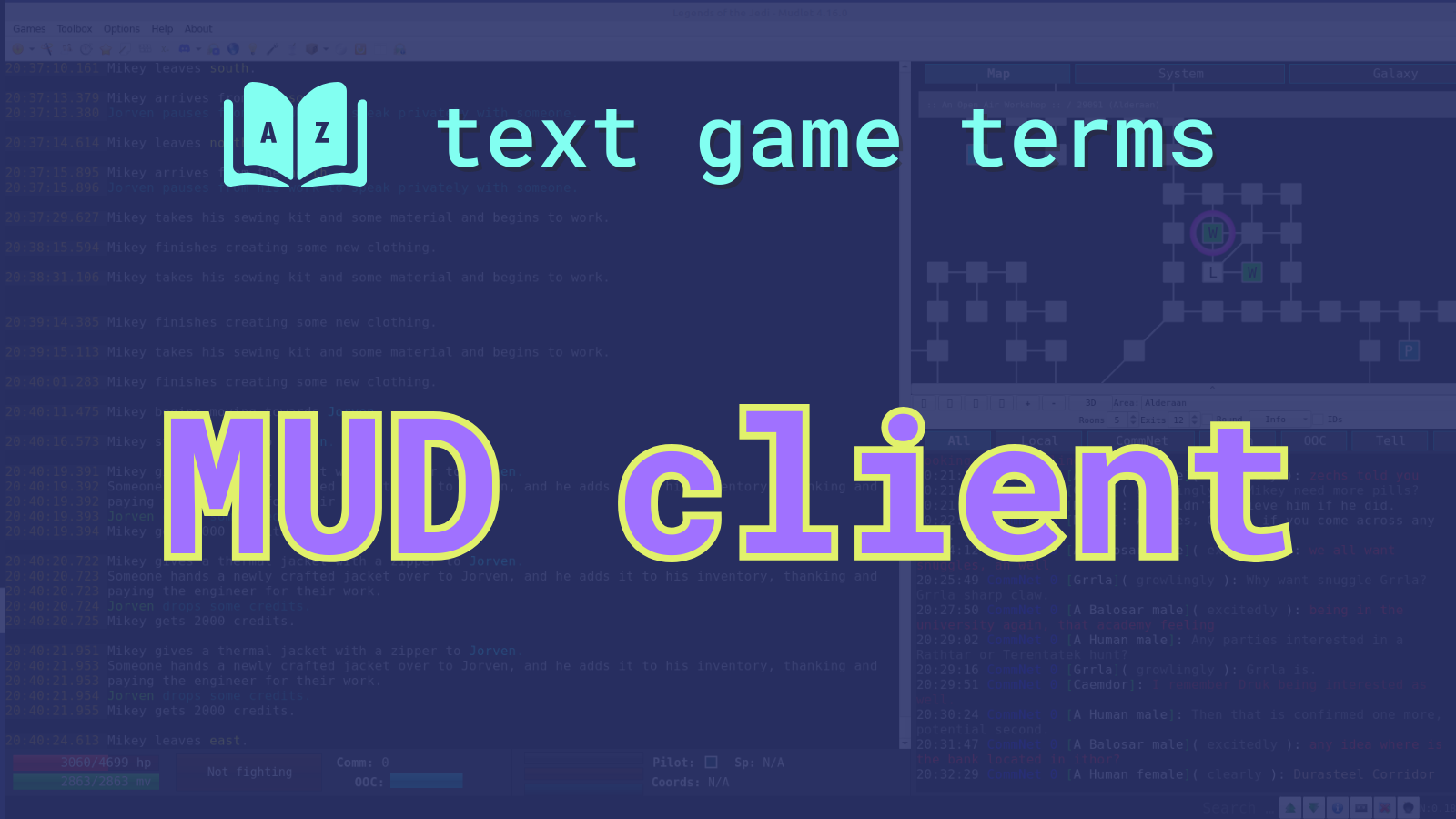
What is a MUD client? A MUD client is a software program specifically designed to connect players to multi-user dungeons (MUDs), which are text-based online roleplaying games (RPGs). MUD clients offer a range of features such as the ability to change the way text appears on screen, macros and triggers, and enhanced logging. In technical

Next