
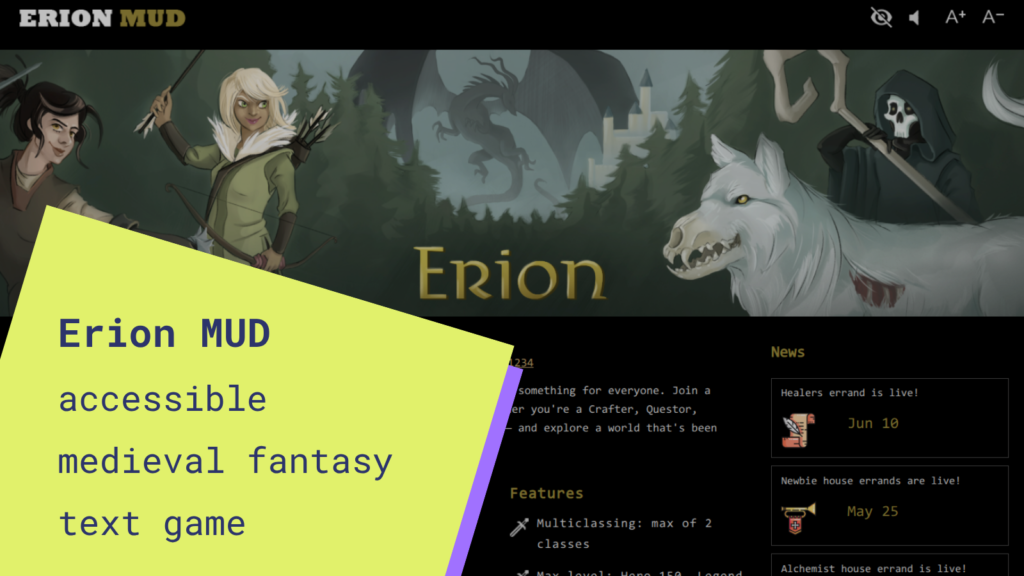
Erion is a free medieval fantasy multiplayer text game that has been around since 2005.
Brandon Cross, who I interviewed earlier this year, recommended it as a game that handles accessibility well.
That rec led me to Aelyn, one of the Immortals who creates and manages Erion.
Actually, Aelyn and her game were originally recommended to me by Opie in 2024, but we weren’t able to connect at the time for RL reasons. Brandon’s interview gave me the nudge I needed to reach back out – and I’m glad I did.
In today’s interview, Aelyn talks about how she develops the game, the work that has gone into supporting VI players, and some of the exciting new changes released for Erion’s 21st anniversary.
Meet Aelyn: programmer, fantasy reader, and keeper of 4 cats
Aelyn lives in the Midwest United States. She and her husband (known in-game as Lucius, the God of Adventure) recently moved from North Carolina to be closer to family. They share their home with four cats: Luna, Appa, Simon, and Buddha.
When she’s not working on Erion, Aelyn enjoys watching her favorite shows and reading fantasy and fiction, mostly young-adult. Sarah J. Maas is her favorite author.
From World of Phoenix to the world of Erion
Aelyn has been part of the multi-user dungeon (MUD) scene since junior high. Back then, a group of her friends played a game called World of Phoenix, which ran on the RoT codebase by Russ Walsh. And like many of us, once she started, she was hooked.
She still laughs about her first character:
“I had absolutely no idea what a MUD was, so I created a character named ‘HolyGrail,’ thinking it sounded perfectly medieval fantasy. I quickly learned that I was supposed to be roleplaying an actual character and had to rename myself to something that fit the game’s rules.”
Around the same time, Aelyn also started learning C, and later Lua and C++. She thinks she likely picked up the interest from her dad, who she says “has always been in his lab programming and tinkering with computers.”
Today, Aelyn sees her primary role on Erion as programming and debugging.
Developing with voice controls
Something that sets Aelyn’s workflow apart from most developers is that she doesn’t type with her hands.
Because she has neurogenic thoracic outlet syndrome (NTOS), she instead uses Talon Voice, a free and open-source software that lets users control a computer by voice and eye tracking.
“Surprisingly, I genuinely prefer using voice controls and would probably still use them even if I regained full use of my hands for typing,” she said.
“I’m incredibly grateful for the software because it’s the reason I’ve been able to continue pursuing a hobby I’m so passionate about.”
And the hobby has mattered more than ever in recent years.
In 2024, Aelyn experienced a rare nerve injury, and last year, she had surgery involving eight sacral nerves. Recovery has been long, and she’s still in physical therapy.
“Writing and programming for Erion has been an amazing creative outlet while spending so much time resting and recovering,” she said. “I’m very grateful to have a hobby that keeps me engaged and excited even on difficult days.”
Erion MUD: a content-rich medieval fantasy world
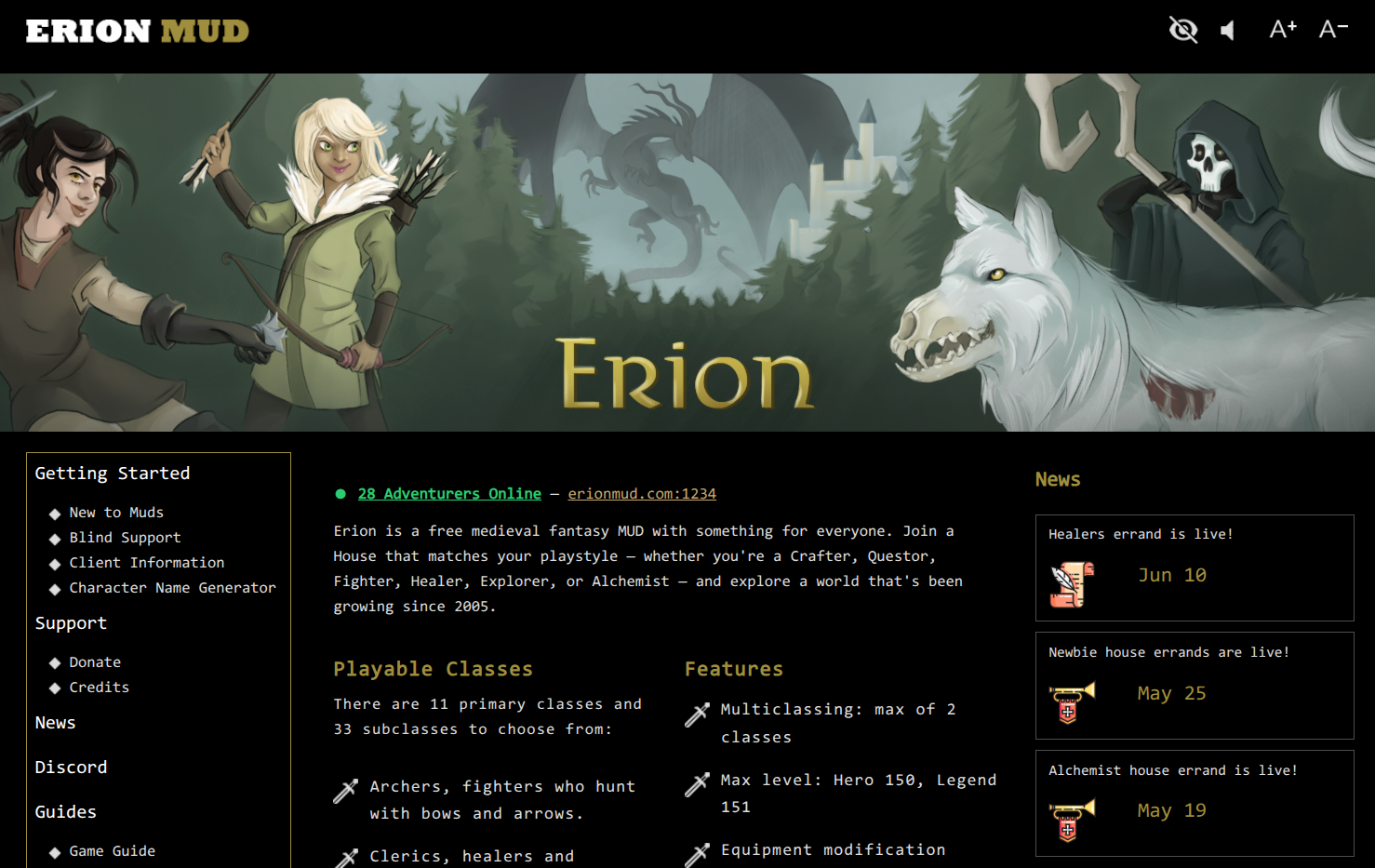
Aelyn describes Erion as “a free medieval fantasy text-based game with something for just about everyone.”
While writing this article, I played Erion for a weekend (I try to make time to play all the games I do interviews for), and one of the things that most stood out to me is that there is a near endless amount of things to do in the game.
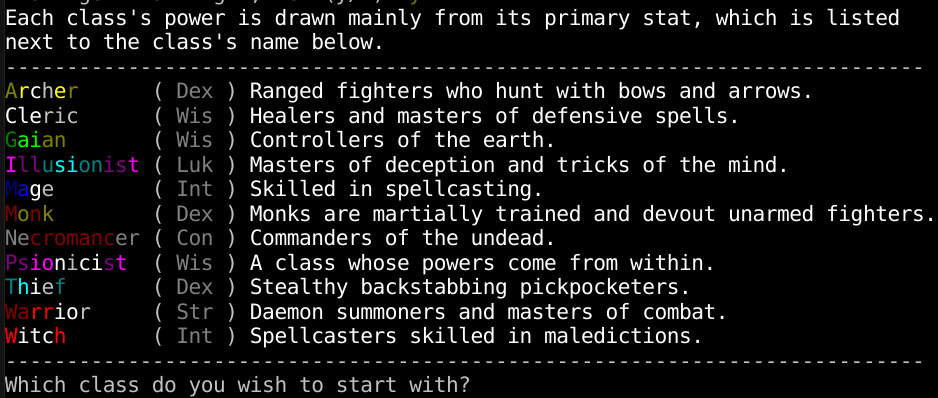
For starters, Erion offers 11 primary classes split into 33 subclasses, lets you multiclass up to two, and tops out at Hero level 150 or Legend level 151.
Equipment can be modified with runes and gems, and players can pick a mode that suits them, including Hardcore, Permadeath, and Pacifist.
More than 350 story-based missions are scattered across the world, alongside a faith system, fishing, farming, and seasonal leaderboards. (There’s also House errands, expeditions, global quests, global junkyard events, and… yeah, like I said, there’s a lot, lol.)
One of your early missions instructs you on how to find your first House (Newbies), but later you can join one that suits your playstyle, e.g. Artisans for people who enjoy crafting or Healers for those who enjoy being in a support role. More on Houses in a bit.
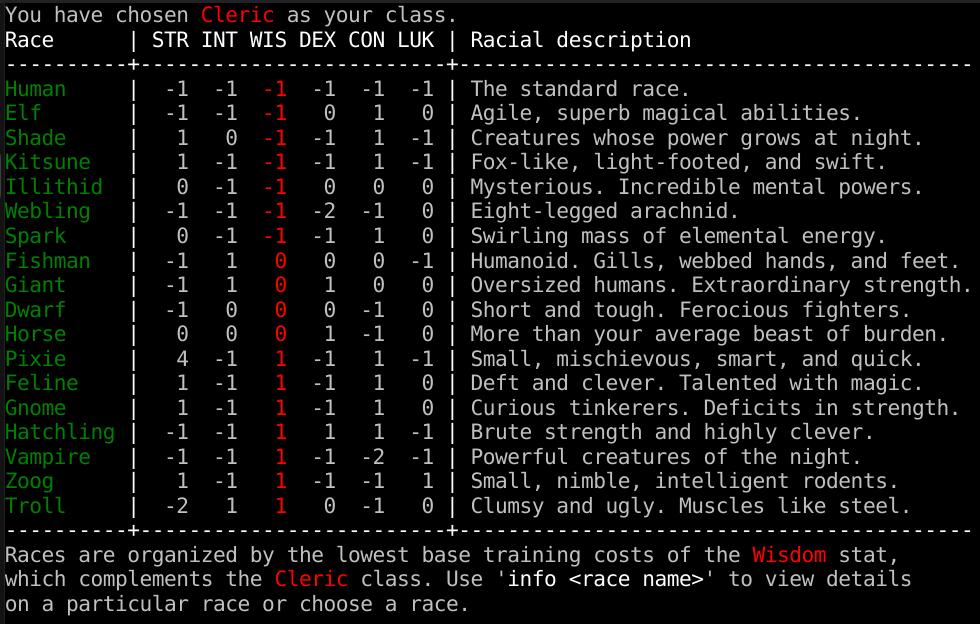
The race roster also includes far more than the usual elves and dwarves, with options like Illithid, Kitsune, Shade, Spark, and Webling.
There’s even an unscramble-the-phrase game and a guess-the-phrase game with their own leaderboards to match:
![[SCRAMBLE] Can you unscramble the phrase? The scrambled phrase is: a tltsiarhg oblsoms](https://writing-games.org/wp-content/uploads/2026/07/Erions-scramble-game_example.webp)
![[GUESS] Guess the Phrase has started! The phrase is: - ------ -o-](https://writing-games.org/wp-content/uploads/2026/07/Erions-guess-the-phrase-game_example.webp)
And for those who appreciate quality-of-life features, Erion offers several that stood out to me within my first hours of play:
- Oscan to see important features and items in your current and surrounding rooms
- Runto to auto-run to an area without having to navigate there manually
- Compass to auto-run to predefined locations of interest in your current area (also allows you to add your own custom points of interest)
- Account-wide vault storage for stowing all the things you’ll pick up while exploring
The game guide helpfully explains these and more.
Because there is so much going on, it can be a little overwhelming for a first-timer. I recommend checking out the toggle command and its siblings: battlespam, notif, and spam.
Together, these settings let you customize what you get messages for. For example, not interested in playing guess-the-phrase? No problem. Type ‘spam guess’ to toggle it off or back on again.
The donation and credits system
Okay, quick detour. Erion does have a system where RL donations are rewarded with in-game perks. I thought it would be good to address it directly, since it’s on the website and some readers might be turned off by the idea without a bit more context.
Here’s what I learned about it from Aelyn:
“I’ve been a gamer for a long time, and pay-to-win mechanics are something I’ve always disliked as a player,” she said.
“So when I started building Erion, I made a deliberate point not to bring that into my own game. The credit system exists purely for optional convenience and customization, and as a way to give back if you feel moved to. None of it offers a gameplay or power advantage over other players.”
Aelyn added, “That said, running a MUD does have real costs and is extremely time-intensive, so donations help keep the lights on, and I’m genuinely grateful for them. But nobody needs to spend a dime to fully experience or succeed in Erion.”
Cleaning up the code
Speaking of time-intensive projects, a lot of Aelyn’s effort has gone into the codebase itself. One of her biggest long-term projects has been converting large portions of the game from C into C++.
“That transition has made development significantly safer and more manageable,” she said, “especially compared to the old days of accidentally going out of bounds on an array and getting almost no useful debug information on a game crash. I genuinely enjoy working in C++.”
As for what keeps her motivated? Well, part of it’s the nostalgia, she admitted:
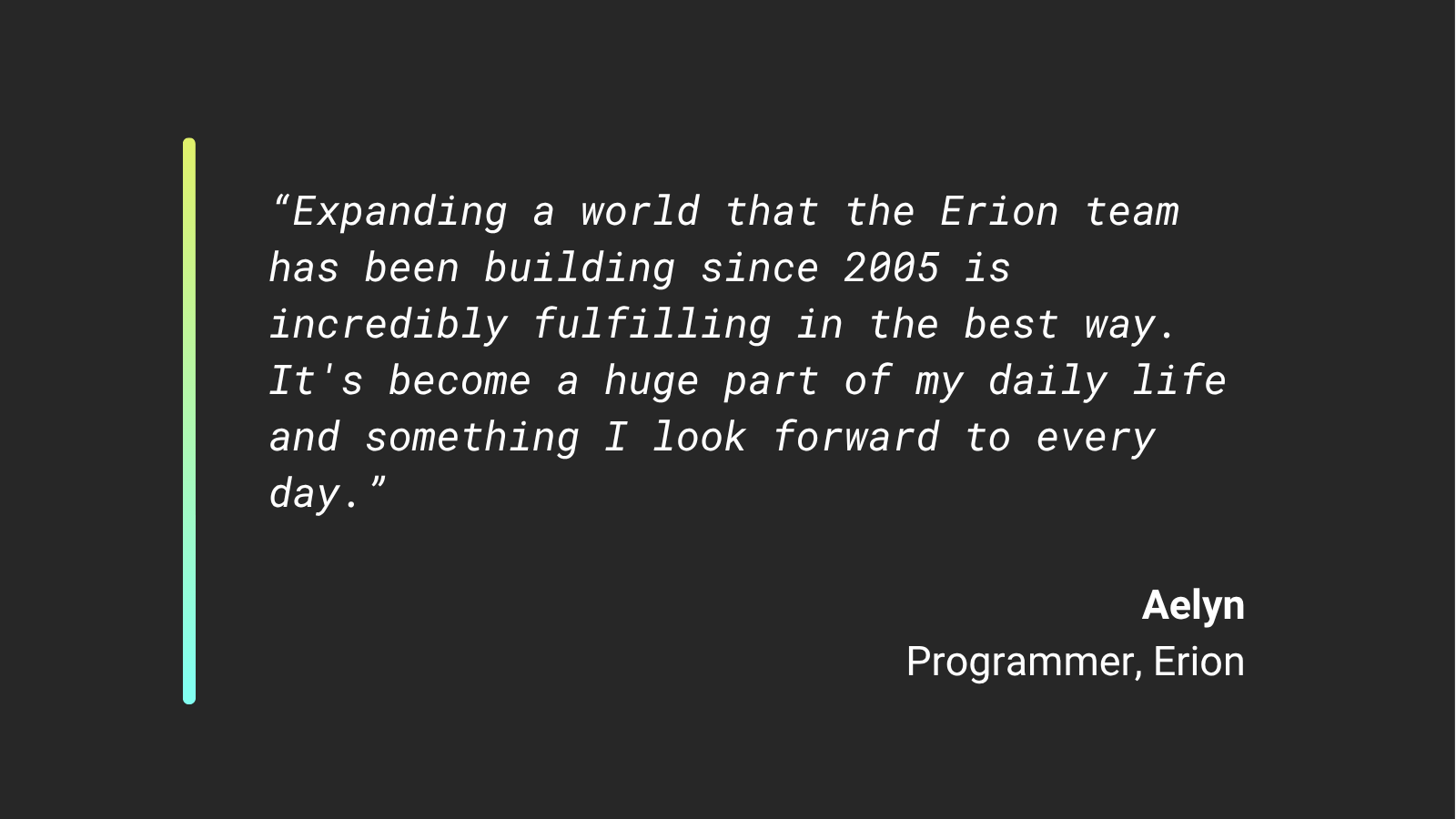
“It genuinely feels like I grew up with [the MUDs I played],” she said. “Beyond that, I love creative writing and programming for fun. Expanding a world that the Erion team has been building since 2005 is incredibly fulfilling in the best way. It’s become a huge part of my daily life and something I look forward to every day.”
Accessibility in Erion MUD
Accessibility has always been a focus in Erion, and many of the game’s players are part of the VI community.
Here’s a quick rundown on its features:
First, there’s a custom soundpack Aelyn has been building for several years, and which currently sees use among the playerbase.
The game also offers a range of toggles and display options meant to make the game’s output easier to read – like the spam and battlespam commands I mentioned earlier, and of course a screen reader mode. The game is free of ASCII art, and you can see that even on its intro screen, which is simple and to-the-point:

It’s an ongoing process, though, and one that Aelyn and her team are happy to work on:
“I regularly continue adjusting systems and output throughout the game to make navigation and gameplay smoother for visually impaired users,” she said. “We’re always open to player feedback about how text is displayed or formatted.”
For VI players thinking about giving Erion a try, the game’s blind support page lays out the various options and is a good place to start.
Quality of life and learning from players
When I asked Aelyn about the lessons she’s learned over the years, here’s what she had to say:
“Quality-of-life improvements matter far more than developers sometimes realize,” she said. “Small frustrations add up quickly in text games, so even tiny usability improvements can dramatically improve the overall player experience.”
Aelyn also noted that community feedback can be a useful resource:
“Many of the best ideas or improvements have come directly from listening to player experiences and suggestions.”
And for anyone thinking about embarking on a similar project, Aelyn had thoughts similar to what you might hear from Mo or Hiro, though she’s been programming for longer.
When she first started, she learned by reading open-source MUD code and asking questions on Stack Overflow. Today, she admits the options for learning are a bit different.
“Now with AI, you can ask anything and get immediate answers and example code,” she said. “Everyone has a different opinion on AI, but no one can deny that it’s an incredible tool for learning how to program.”
Even so, she encourages would-be devs to look at, and learn from, real examples:
“One of the best resources is simply existing open source MUD codebases and communities. Reading other people’s code teaches you a tremendous amount. Play around with the code to understand it. Between open-source codebases and AI tools, you can learn an incredible amount very quickly.”
What’s new on Erion
Okay, back to Erion for a minute. If you’ve played before but haven’t been keeping up with the news, you might be interested to learn about House Errands.
Each errand is a task handed out by the House representative, shaped around that House’s identity. For example, House Luminati, which centers on quests, exploration, and puzzles, sends players hunting for jigsaw puzzle tiles scattered across a highway to spell out a word and solve a riddle.
The other Houses each get their own flavor. The Artisans craft and deliver a list of items, the Slayers hunt down a dangerous group and its boss, the Alchemists brew and deliver potions, and Newbies work through a hundred-question exam at their own pace. Errands are included in the overall and seasonal leaderboards, too.
The pantheon has grown, as well.
The team recently introduced Velkara, Goddess of Justice and Mercy, and built her a home: Temple Veritas, a level 55 area Aelyn created with Kextra, complete with high priestesses and priests, pilgrimages, and new missions, plus ten new divine skills and spells for her followers.
Two other recent changes worth noting:
Erion has removed player killing entirely and become a fully PvE game, and it has added a 256-color “xterm” toggle for players whose clients support it.
There’s more on the way, too!
Aelyn expects the next deity to be a God of War. She says Kextra has been building a seasonal Halloween area that consists of just under 200 rooms, packed with missions, hidden secrets, and goodies. Darkbuilder is writing new missions, and Aura is working on new areas to explore.
Giving credit where due
When I asked Aelyn if there was anyone she wanted to thank, she credited several people with Erion’s success:
“Kextra has been my partner in crime on Erion for over a decade, and I can’t thank her enough for all of the incredible creative writing she’s contributed to the game. She is absolutely the queen of hidden exits and hidden items.”
She also thanked Darkbuilder for the many missions he has written over the years. “A lot of them are massive, ambitious, and incredibly memorable,” she said.
Aura and Cortheus are two other immortals on the game who each play important and unique roles in helping Erion continue to grow.
She also wanted to recognize Kane, now retired, who implemented Lua into the codebase years ago. “Erion would not be what it is today without it,” she said.
And last but not least, Aelyn expressed her gratitude for Erion’s players. “Seeing people continue to enjoy and support a world we’ve all spent so many years building means a lot to me.”
A warm thank you to Aelyn for sharing her (and Erion’s!) story – I’m glad we could finally connect! And a quick shout out to Opie and Brandon Cross for sending me Aelyn’s way in the first place.
Curious to check out Erion for yourself? You can connect via Telnet at erionmud.com on port 1234, or visit the website for more options. Don’t forget to join the community on Discord!
Notes
A staff member in a text-based game with elevated privileges, such as the ability to create content, enforce rules, and manage the game world. See imm for the full definition, examples, FAQs, and more. ↩
The underlying software that runs a multi-user dungeon (MUD). See codebase for the full definition, examples, FAQs, and more. ↩
Visual elements, such as maps and objects, created using text only. See ASCII art for the full definition, examples, FAQs, and more. ↩
A type of gameplay where players face challenges from the game’s environment, quests, and NPCs rather than from other players. See PvE for the full definition, examples, FAQs, and more. ↩


Leave a Comment