
Starmourn is a free, multiplayer sci-fi text game from Iron Realms Entertainment. Released into beta in 2018, it entered Legacy Mode in 2023 and is now run entirely by volunteers.
The game recently piqued my interest when a post on r/MUD announced two new co-op features, Fleet Mining and Crew Hacking. I was surprised, since I was under the impression that the game wasn’t receiving further development. I decided to reach out to the team to get their side of the story.
In today’s interview, staff members Argus and Marra share what makes Starmourn special, how the game became a volunteer-run passion project, and what’s new on the horizon.
Meet Argus and Marra, volunteer co-producers
Argus is a Creative Manager based in the northeast United States. She describes herself as having a “penchant for ephemeral hobbies,” the latest of which is wood carving.
When she’s not working on Starmourn, she’s doing the rounds at local coffee shops, hiking with friends, or marathoning murder mysteries with her two cats.
She initially got into MUDs as a joke: after a friend’s husband told her about Achaea, she made a character so she could count herself informed when she told him it was lame. Instead, she found herself hooked. 😂
Marra works in advertising as Digital AdOps after briefly studying to be a Library Technician, where he acquired an appreciation for systems that support communities.
“My hobbies are much the same as most people that fall into these kinds of games,” he said. “Reading, gaming, worldbuilding and roleplaying – and in my opinion, all of these are best shared with friends.”
He found his way into MUDs as a bored pre-teen looking for online browser games. After coming across Lusternia, he decided to give it a try. That first stint was brief, but he ended up coming back: “It’s been 20-something years by now, and I wouldn’t trade the experience for the world.”
Their roles on Starmourn
While both Argus and Marra hold a Producer title, they fill complementary roles on the team.
Argus’s most important job, as she sees it, is making sure things run smoothly so that players can fully immerse themselves in the game. She also manages the social media accounts and web blog, and has been learning how to code from Elan, the team’s lead coder.
“But my most fun job is the building of it all – areas, mobs, quests, events, systems,” she admitted. “It’s been a wild ride.”
Marra describes his part as “more curatorial and historical, like that of a creative director.” In his day-to-day, he acts as something of a lore keeper for the game.
“There’s quite a lot of proposed content, and it’s my responsibility to iron out loopholes, broaden our horizons, and keep a watchful eye over continuity and canon,” he said.
Starmourn: roleplay freedom amid an original space opera setting
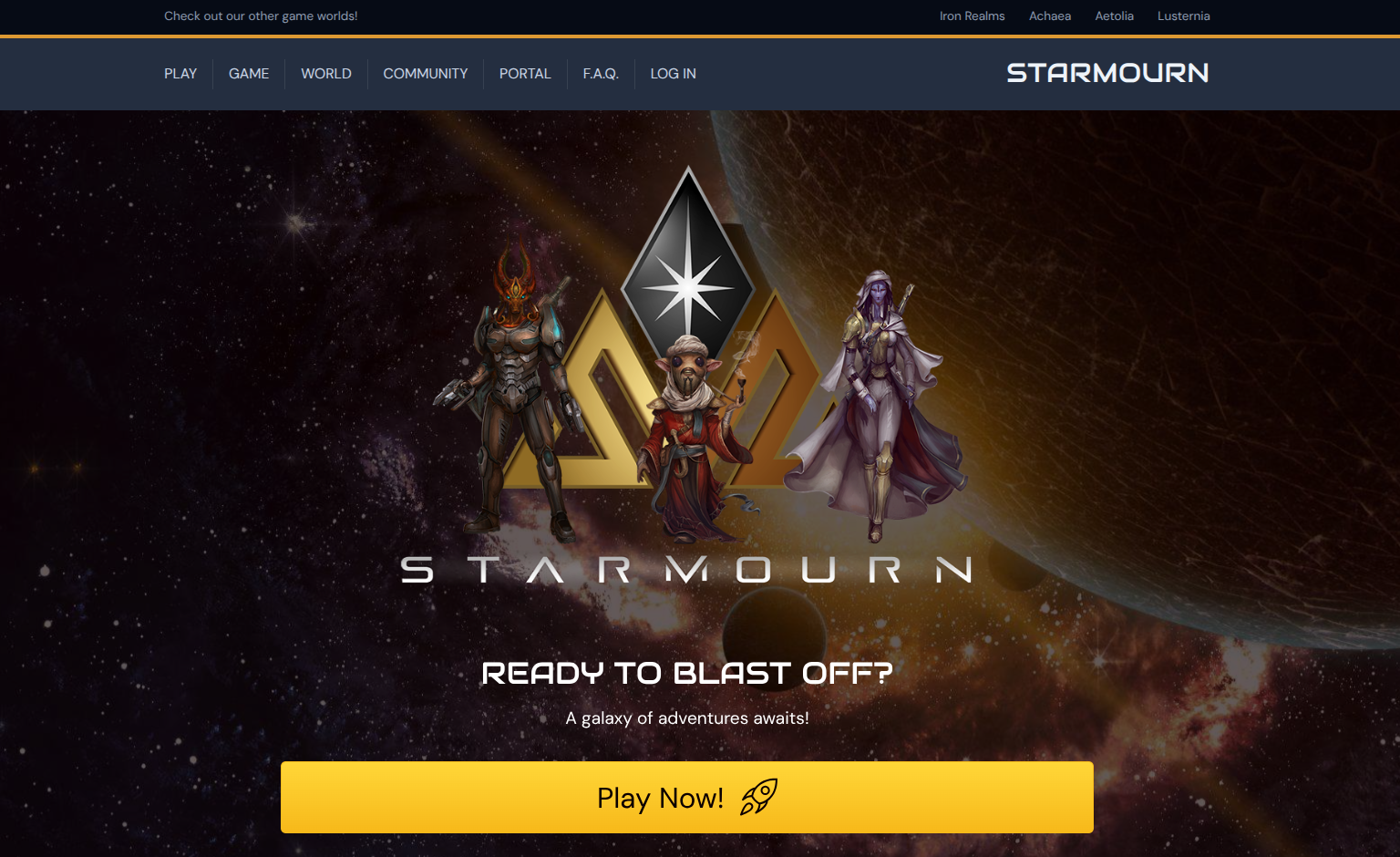
So what is Starmourn, and what makes it special?
For those new to the hobby, Argus describes Starmourn as “a sci-fi MUD set in the aptly-named Starmourn space sector, where players explore many literal worlds on-foot or by flying custom starships as the community faces off against the ever-looming Ishvana threat.”
In Marra’s words, it’s a “live adventure RPG set in an interactive sci-fi fantasy setting, where wars and blood-feuds have cooled into three key factions.”
Specifically, those factions are The Celestine Ascendancy, Scatterhome, and The Song Dominion, which you learn about (and get to choose from) during character creation.
If you like games with a breadth and depth of lore, Starmourn won’t disappoint.
In addition to its 3 player factions, the setting includes more than 50 alien races and civilizations, with 14 playable races and 5 classes:
- B.E.A.S.T
- Engineer
- Fury
- Nanoseer
- Scoundrel
…all custom-built to fit the living, breathing Starmourn universe.
Players not only get special class-based skills but can train skills in 4 general categories shared by all classes:
- Skirmishing
- Exploration
- Captaincy
- Hacking
The game also features a unique healing and regeneration system called Wetwiring, which is designed to make combat more fluid and less about quaffing potions mid-battle.
And if you’ve ever thought to yourself, “We need more MU*s with spaceships and space travel and space combat,” you’ll be delighted to learn that Starmourn has an expansive space system with, well… all of those things!
Soon after finishing the tutorial, you’ll have the option to pilot a ship for the first time as part of the game’s main storyline.
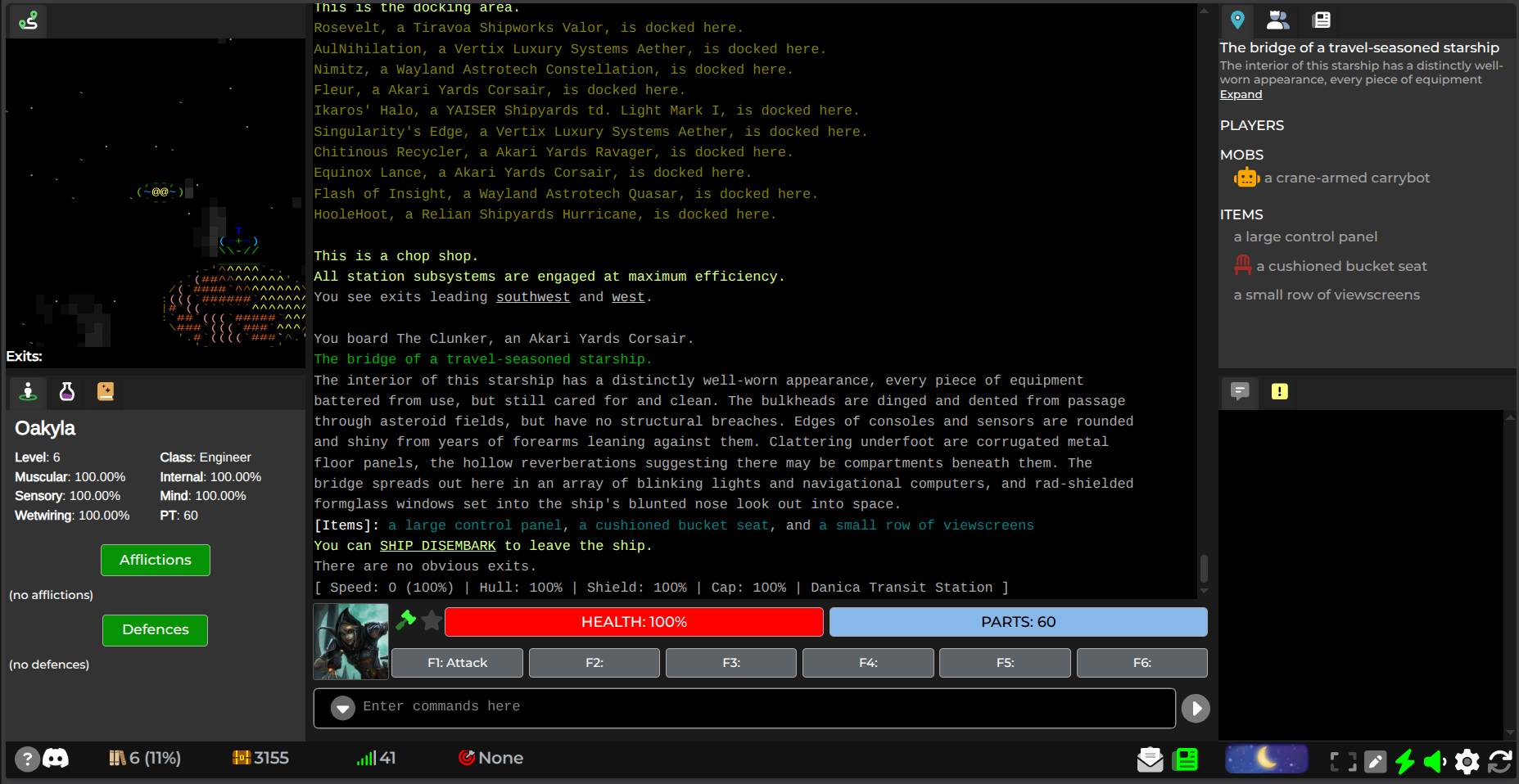
After launching into space, you’ll navigate the map in 2D. The starskipper I’m flying is represented here by a green @ with a line serving as the tail. This is how you can see your ship’s current bearing:
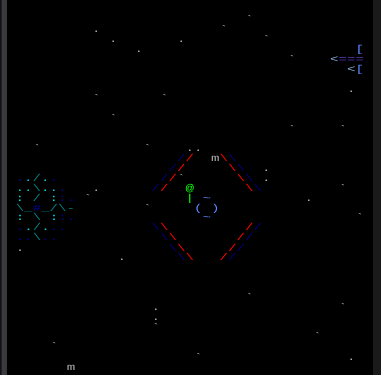
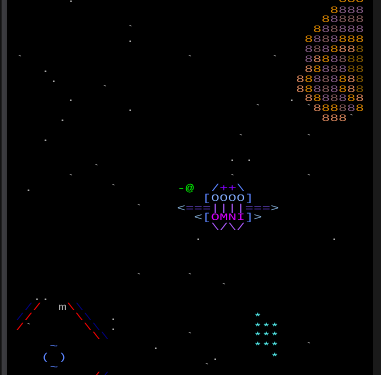
While it felt a little overwhelming at first, traveling through space definitely gave me the impression that the Starmourn sector is a big place with plenty to explore!
This post barely scratches the surface when it comes to the sheer number of places you can go and things you can do.
Tip: I found HELP SHIP COMMANDS and HELP VOIDGATE extremely useful while learning how to get around.
Argus credited the game’s origins as part of the reason it stands out:
“We have the benefit of [Iron Realms’] browser-based Nexus client, with decades of learning and experience informing the design decisions and modern MMO gameplay loops informing ongoing development.”
But the biggest thing that sets Starmourn apart, according to Argus, is the how its systems support player roleplay and archetype paths on a scale you don’t see in most games.
From pop idol to space pirate
“Folks might think I’m joking when I say you can meaningfully roleplay anything from a pop idol, to a space pirate, to a researcher, but I mean it!” she said.
There’s built-in support for freeform performances, whether you jam solo or in a band. And a piracy and warden system where your activities can alter intra-sector politics as you play. And archaeological sites you can access through passive exploration, with the ability to study the findings in cooperative research sessions…
“And that’s just the start of it!” said Argus.
“You can be an industry tycoon in space mining or with a personal storefront; a speedster setting up custom checkpoints in space and racing other players for street cred; a hacker and info broker pulling the strings behind the sector’s strongest, a mercenary for hire for anything from space defense to bounty hunting to cake decorating… It’s not just PvE bashing and PvP to grind through – the list of what you can become goes on and on.”
And if none of those fit, players still have options.
“If there’s something totally new you want to explore, we have a REQUEST system through which you can work directly with us admin to flesh out storylines or complete new building efforts,” said Argus.
“MUDs, in my experience, have a massively unique depth and community that brims with a potential unmatched in any graphical MMO. You as a player have an active connection to the game admins, meaning you have unparalleled access to shaping the game world and building a legacy…” — Argus, Co-Producer, Starmourn
Crafting, design trends, and player-run shops
Marra took a moment to gush about a different aspect of the game: player crafting.
“Unlike any other MU*s that I’ve heard of, we offer players near limitless ability to customize and craft clothing, gear, food and drink, furniture, housing, ships, and all sorts of odds and ends,” he said.
Trade skills in Starmourn include design skills such as Cuisine, Fashion, Jewelry, Mixology, Furnishings, and Art, as well as modding skills such as ArmorModding, ShipModding, and WeaponModding.
The game doesn’t just allow that creativity, he added. It encourages and rewards it, with daily engagement rewards, repeatable design quests, and rotating “design trends.”
Design trends are a neat system I hadn’t seen in a MU* before. Basically, keywords are chosen randomly each week, and if a player uses those keywords in their designs, they get a boost to their sales from NPC buyers.
Accessibility and QoL in Starmourn
Starmourn features several settings that make the game friendlier toward screen reader users, including modes that remove decorative ASCII from menus and make the space map easier to read aloud.
You’ll find these settings and more by typing CONFIG.
On top of that, Starmourn has some quality-of-life features that make it more convenient for everyone to play, such as the SHIP BEACON command, which helpfully describes points of interest around you while in space so you don’t have to rely on visuals alone:
                                    [ Entities Nearby ]

Dist Dir Zone            X   Y     Description
7    se  Aleph           125 125   (c) a station called Omni Station
16   nw  Aleph           109 108   a mineable asteroid (#6956)
20   se  Aleph           130 138   the Asteroid RS-4040-Cindam
22   ne  Aleph           140 110   the Asteroid Lamentation
25   sw  Aleph           105 140   a voidgate called Aleph
29   n   Aleph           122 91    a mineable asteroid (#9137)
34   s   Aleph           129 153   checkpoint #77 - a checkpoint structure
34   se  Aleph           150 138   autofactory #22 - an autofactory structure (T1)
37   ne  Aleph           150 97    refinery #21 - a refinery structure (T1)
40   sw  Aleph           85  140   an Aegisphere (#1)
Players also have the ability to set their own default colors, automatically navigate to space destinations using SHIP TRAVEL, and quickly get around on foot using LANDMARKS.
Landmarks are standard locations you can WALK TO, and you can even add your own custom ones, as well. You can also type AREAS at any time to get a list of hunting locations appropriate for your level.
Additionally, there’s something called command queuing, which helps with time management in fast-paced situations like combat. For more info on how it works, type HELP QUEUEING in game. You’ll also want to enable the feature with CONFIG USEQUEUEING ON.
For those who prefer to customize their sounds, the Nexus client lets users upload custom sound files for in-game events and triggers. There’s no official soundpack yet, but it’s on the team’s to-do list, and they’re on the lookout for help with its creation.
“I’m sure there’s a lot of room to improve further, and we’d love any feedback our blind and visually impaired community has to share!” said Argus.
Tip: If you’re new to IRE games, the default display modes for room descriptions, NPCs, items, and exits might feel like a lot at first. Try toggling these settings to find a combo you like:
- CONFIG CONDENSEROOM OFF
- CONFIG CONCISEROOM ON
- CONFIG CONCISEEXITS OFF
I also recommend using the Nexus client if you’re a visual player and it’s your first time playing – it has a built-in mapper and many other features that make viewing information more convenient, especially for a newb like myself.
How Starmourn became a volunteer passion-project
Now that we’ve covered what Starmourn is and how it’s different, let’s circle back to the question that got me started down this path in the first place:
Why did Starmourn end up in Legacy Mode, and what motivated the team to continue working on it anyway?
Argus explained it like this:
“Due to some initial launch struggles in that very early period, player population declined and Starmourn struggled to be profitable for quite a while. It’s hard to rationalize paying for staff support when a game is no longer generating income, and in 2023 IRE made the choice to put Starmourn into Legacy Mode. Many thought that meant the end of Starmourn, but it’s much less severe than all that. Really it just means we are fully volunteer run and free to play.“
Argus had joined the team a few years after launch, and she stepped into the producer role after the Legacy announcement “as a sort of declaration of my intent to stay and continue development,” she said.
“Marra, Elan, and I stuck around for love of the community and the game world that we spent so many years building. I genuinely believe the Starmourn sector is a magical place, and there are so many stories still to tell.”
When I asked what keeps her motivated, she said, “Every time someone shares an ‘Oh this is COOL’ comment about something we’ve made, it adds a few years to my life. (ha!)”
Marra joined the game as a player, drawn in by its expansive setting and its positive treatment of roleplayers – especially those interested in the crafting and design side of things.
“I’d never experienced a game that was so welcoming to someone who did not enjoy PvP or PvE conflict,” he said.
Marra signed on as a member of the admin team to help expand and refine the wiki but soon found himself writing rooms for “the ice-bound starship wreck of Paperweight, the soaring majesty of the Subrosa Palace, and the glitz and glamor of the Glittering Shores.”
Since then, he’s worked on many of the game’s new releases – and even hinted that his favorite is yet to come.
“MU*s offer something remarkable that no other game could possibly manage; an interactive world that genuinely changes, for better or for worse, along with the story that the community helps to tell.” — Marra, Co-Producer, Starmourn
The realities of volunteering
So, what’s it like working on a Legacy IRE game? Argus suspects Starmourn’s biggest challenges are shared by every passion-built MU*.
“We’ve got a small volunteer team working fulltime jobs, with real social lives, some with growing families, all on asynchronous schedules while trying to build the best game imaginable,” she said.
They manage it all by being upfront with each other about their motivation levels and by inspiring each other through teamwork.
When Argus is building a mob with an unusual personality quirk or history, she might tag in Marra to help flesh it out, “re-energizing both of us with the collaboration,” she said.
At other times, recharging her batteries might mean taking a week away and trusting the team to handle the slack.
Recently, Marra lost his window of overlap with the rest of the team, which has made it more difficult for him to participate. He copes by hunting for inspiration where he can find it: “Becky Chambers, Tamsyn Muir, Stellaris, and Neon Odyssey have my heart at the moment!”
And going into Legacy Mode hasn’t resulted in isolation, either.
The other Iron Realms admin teams keep Starmourn looped into their large-scale initiatives, including a massive inter-game Winterflame event last December, where players sent gifts between all the IRE game worlds.
And right now through the end of September, you can join the Iron Carnival, an inter-game event featuring its own NPCs, 6 carnival areas to explore, exclusive shops, and more.
“It’s beautiful to still have the IRE team’s support and encouragement,” said Argus.
Lessons learned: stay flexible, keep it fun, and make it make sense
Argus had a few lessons to share from her time working as an admin on Starmourn.
First, her advice for new storytellers:
“Stay flexible,” she said. “Few things are as unsatisfying as having a multipage event plan that players derail two bullet points in. Whether you’re running a D&D campaign or a MU* event, players are creative and you cannot script every step they’ll take.”
The solution? “Establish key points that MUST be hit, and otherwise just make sure you’re ready to pivot flexibly for anything that happens in between.”
Second, her advice for handling feedback:
“You can’t take bug reports personally,” she said. “Something will always break or not work as intended or create an unintended exploit, and it’s not a reflection of your level of care or attention when someone points it out. It’s just an opportunity to improve and something to learn for next time.”
Argus had two more tips, one for working with a small team and another for working with a small playerbase:
Scope each project to what you’re personally prepared to finish alone (it spares the team tension when schedules get crowded), and work on projects that are fun for you.
“Bug crushing sprints are important and necessary, but you also need to work on things that spark joy to prevent your passion becoming a chore,” she said. “Plus, I think players can feel it when you bring them new content that you really loved working on, and it’s often the most fun content for them to engage with too!”
Marra shared a few tips of his own:
First, “make it make sense.” Immersive worlds don’t need to be perfectly true to real life, but they do need to be internally consistent and follow their own established rules.
And it’s important to consider the consequences of those rules, too, and to remember that “limitations cultivate creativity,” he said.
For example, in Starmourn’s setting, advanced nanites are both extremely versatile and extremely common. They make up the wetwiring system that keeps your character healthy, and they even make eating food unnecessary to survive.
“Nanites can replicate just about any solution as required; this means that, unfortunately, the simplest answer to any problem is typically ‘nanites fix it’.”
This class of problem is exactly why limitations can be a good thing for a game’s setting.
“Thankfully, players have been excellent sports about not using this universal skeleton key, choosing to have collaborative fun with events rather than seeking out ways to brute-force through the narrative,” said Marra.
He added, “Don’t let perfect be the enemy of good. No project needs to start life as your magnum opus. Do something fun, or practical, or experimental, and start basic.”
Lastly, he urged readers not to take their fellow players for granted:
“Treat your player community with love and respect, because at the end of the day, our little corner of the internet depends on forging connections with one another and collaborating to share a story together, and that’s true for every part of the MU spectrum… There will always be people you don’t see eye to eye with, and there will always be some people for whom disciplinary action is essential, but you can’t ever lose focus on the needs of your community, or your obligations to your fellow players.”
Recommended resources for would-be MU* builders
Argus has never programmed a MU* from the ground up, so she deferred on codebase questions, but she did have solid advice for new teams:
“From a project management perspective, you need to have a scalable resource for knowledge sharing and record keeping. All your projects, especially new systems, should be built and maintained so that someone new can join the team, open a doc, and pick up where you left off.”
That might mean using a formal tool like Asana or Jira, a custom wiki, or a series of Google docs. “The more comfortable you are with the system, the more likely you are to actually use and maintain it,” she said.
She also recommended keeping meticulous lore records (timelines, cultural relations between NPC and player orgs) from the very start of a project, so the world stays thematically consistent as it grows.
Marra agreed, and pointed to Starmourn’s own setup as an example: a public-facing wiki for reference material, a private archive of indexed Google docs for mapping and brainstorming, and a private IRE-facing wiki for system documentation.
Both also had something to say about generative AI.
As we saw from the State of the Niche survey earlier this year, people in the niche view it either as a good thing or a bad thing – and sometimes both.
Here’s where Argus and Marra stand:
“I won’t tell anyone not to use AI, but I do believe that the best stories are written by real people and that your ideas are worth sharing,” said Argus. “If you’re creative enough to be thinking about starting a project like a MU* world, I hope you are also bold enough to make it with your own imagination.”
Marra said, “I will take a harder stance against generative AI; in the most generous characterization, it’s a crutch with profoundly corrosive consequences. If you’re not willing to bother writing a piece of content, you don’t need to write it at all – if it isn’t worth the time to make, it’s certainly not worth the time to read.”
What’s new: Fleet Mining and Crew Hacking
Now, about those releases that led me to Starmourn in the first place.
Fleet Mining, released in mid-May, lets one player pilot a mothership fitted with ore-crushing or gas-compression modules while captains of smaller harvester ships join the operation, deliver raw materials, and split the XP and profits.
“The goal of that system is to help give a tangible reward for veteran players teaming up with newbies, and for groups of players to collaborate together in space,” said Argus.
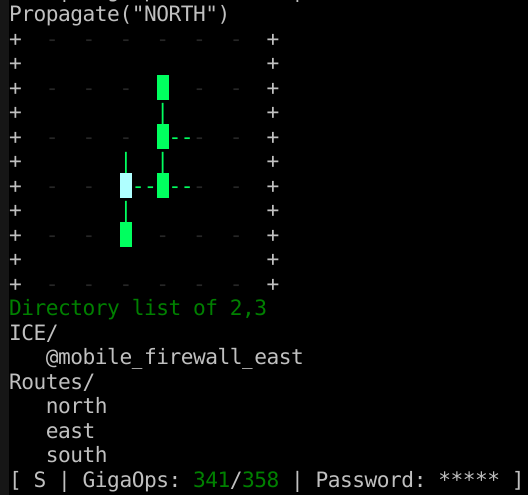
Crew Hacking grants players illicit access to secure areas, communication channels, and money in-game. Now crews can jack into a shared grid and breach it together, filling out the map and password clues for the whole group as each member explores.
In short, both systems are designed to create opportunities for players to interact and work together for rewards.
What’s next for Starmourn
More Fleet Mining work is already in the pipeline, including a dedicated mothership planned for part 2 and, potentially, some combat tie-ins.
“We’ve also got some big dreams for pirates vs wardens and giving players more incentive to really dig into that roleplay activity,” said Argus, “but I don’t want to say too much and give it away.”
The Vihana research event, sidelined for a bit, is expected to return in the coming months. It’s designed to give players the chance to connect with a rather powerful NPC adventurer and conduct research sessions on the Ishvana troops that raid Cosmpiercers and lurk in Facilities.
And then there are the areas in progress:
“We’ve got an area that was half-built ahead of Beta release and is getting buffed out, my personal Elgan mischief project called Lingry, a passion project of Marra’s called the Yfallei Coast, a pirate haven called Port Koggoro cloaked in space, and a rather massive expansion on a player-request called Gwelsir Veil,” said Argus. “Many little steps make progress, they say!”
Marra added to the list, “The lost grove of Orethuil, new archaeological secrets to uncover, a new facelift for the commercial monolith of the Arcopolis, a new game-wide xenobiological system, and more.”
Thanks and acknowledgments
When I asked Argus and Marra if there was anyone they wanted to thank, Argus started her list with Elan, a coder and fellow team member:
“For being my rock since Legacy, encouraging me when I’m feeling disheartened, teaching me about code with impossible patience, and creating some of the most amazing systems out of thin air – it’s certainly magic.”
She also thanked Marra, her “partner in all this creative madness.”
“He is one of my very favorite people in this world, and I am beyond lucky to have him as a collaborator in all this.”
Marra returned the sentiment in kind and also gave credit to Starmourn’s coders, including the retired Neritus, for always helping “to really make magic happen.”
He thanked Lusternia, another Iron Realms Legacy game, “for tolerating an awful 15-year old brat all those years ago,” and gave special mention to two of its volunteers, Mysrai and Drocilla, “for being remarkable role models of both description and roleplay.”
Finally, both Argus and Marra made a point of thanking the players who stuck with Starmourn through the Legacy transition, as well as the new folks who’ve since joined.
Marra’s message to them: “Thank you for making Starmourn a project worth keeping; we’re all here because you made something so special, we couldn’t bear to let it go.”
A big, warm thank you to Argus and Marra for sharing Starmourn’s story so thoughtfully and with so much heart! Best wishes to the team for many more years out in the sector.
Want to explore the Starmourn sector yourself? The game is free to play: you can jump in from your browser via the Nexus client, or point your favorite MUD client to starmourn.com, port 3000. Don’t forget to say hi on the Starmourn Discord!
If you’d like to use my referral link, click here instead or type REFER DEJA in game. You’ll get a few in-game credits to spend on extra lessons, plus more if you decide to stick around. Happy MUDing!
Notes
A character in a roleplaying game that is not controlled by a player, but by the game’s code, an administrator, or written into the environment. See NPC for the full definition, examples, FAQs, and more. ↩
Visual elements, such as maps and objects, created using text only. See ASCII art for the full definition, examples, FAQs, and more. ↩


Leave a Comment